Showing posts with label Extracurriculars. Show all posts

Wednesday, November 28, 2012

Secession: Alex Champion's Entry 11


The past month afforded a few opportunities to think about a touchy constitutional subject: The Annual Tug-of-War between Annapolis and Eastport and the secession petitions following President Barack Obama’s election.  Outside of constitutional scholars, civil war historians, and unreconstructed southerners and their incomprehensibly sympathetic northerners, I probably reflect upon secession more than most Americans.  Despite the considerable baggage, both personally and in historiography, I’ve made my peace with a generally pro-Confederate interpretation of secession’s constitutionality. Arising from states rightist philosophies developing around the Virginia and Kentucky Resolutions and the Nullification Crisis, it contends that the national government is a creation of the states via mutual agreement.

During the height of my secession obsession in High School I realized that a compact is built upon a promise; although the constitution does not contain provisions for exiting the union, the Constitution is essentially a contract and thus breakable only when it is violated. Since the documentary record is rich with references to slavery as the primary concern for the lower south states, the states seized or razed federal installations and captured soldiers leaving at the behest of governors, and seceded for as yet passed and imagined anti-slavery legislation from President-Elect Abraham Lincoln, I mentally entered a condition of gentle superiority in the knowledge that THEY broke the contract instead of Lincoln. It is with this perspective that I view secession here and now.

In the Land of Secesh.

On November 3, 2012 I participated in the 15th Annual Annapolis and Eastport Tug of War. The friendly competition between Annapolis and the formerly independent city of Eastport, in which I live, is precipitated by the secessionist movement known as the Maritime Republic of Eastport. Following the repair and subsequent closure of a crucial drawbridge connecting Eastport with Historic Downtown Annapolis, the Maritime Republic of Eastport “seceded” from Annapolis and thus the United States of America to form its own micro-nation to rebuild Eastport’s spirit and support local businesses. The official reason and purpose was thus:
“The goal was to foster a spirit of independence and merriment in a manner befitting the character of Eastport and at the same time, to celebrate Eastport's proud heritage and quality of life. So the Maritime Republic of Eastport was founded on Super Bowl Sunday, 1998, when patriots residing on the Horn Point peninsula rose up in revolt against the snobbish suppression of ‘Annapolis Proper’ across the harbor. Since that time, MRE has become a force in the community, doing good for the community and having fun at the same time. MRE meetings and activities are open to all.”
 

 The MRE’s motto, “We Like it This Way” appears on its official flag. With a yellow field, the superimposed black shield depicts staples of Eastport culture: a fishing vessel and crab on the dexter, a heron and pleasure craft on the sinister, and two flanking hounds with tennis balls in their mouths.

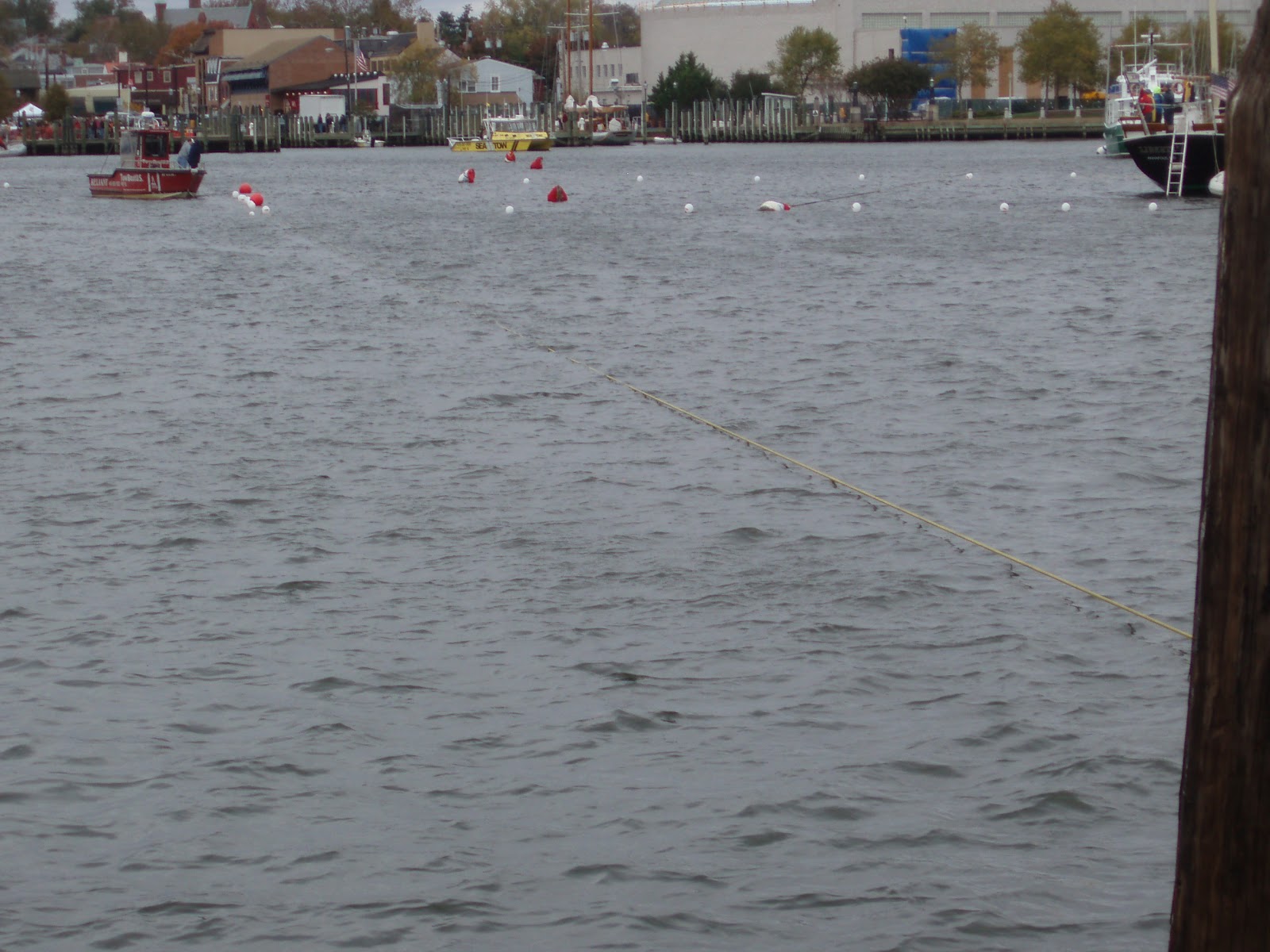
Without guns or canons and minie ball volleys like those rebellious southern states, the Maritime Republic of Eastport and its boosters battle against the Historic Downtown Annapolis and theirs for bragging rights with the 1700 feet rope. The Tug of War competition, also known as the “Slaughter Across the Water...”
 
 
...spans Annapolis Harbor from the Chart House restaurant in Eastport to Susan B. Campbell Park in Annapolis. Naturally the harbor is closed. Also naturally, my team representing Watergate Village Apartments (a sponsor) won.


The re-election of President Barack Obama created the now customary slew of media coverage concerning secession. Just as Democrats did in 2000 but especially in 2004, conservative Americans decried the election of a person representing everything that contradicted their true vision of America.
 
President Obama is probably the third person to be described as a “black president.” Abraham Lincoln, a moderate figurehead of an abolition-leaning party built from a cacophonous coalition of former Federalists, Whigs, Anti-Masons, Free-Soilers, but also liberal and conservative factions within each, was often called a “black Republican” for his alleged positions on slavery. Toni Morrison once claimed that Bill Clinton, whose affair with Monica Lewinsky was treated scandalously by Republicans as if he were a black male, was America’s first black president. Whether or not she truly believed her comments, she illustrated the socio-economic gap of expectations between the common people and the political class.
 
In the blogosphere November 6th is ancient history. Yes, America’s third black president was re-elected. Yes, Republicans are kvetching over the loss. Yes, segments of society of claim they wish to secede. My post was delayed because I hoped the discussion would continue despite the "fiscal cliff" talks and Lindsay Lohan's performance in Liz and Dick. Sadly, a rudimentary Google search for "Obama secession" yields few substantive articles beyond mid-November and virtually none drawing parallels to 1860 when the election of America's first black president precipitated the secession crisis. The articles that do get into the escoterica of "states rights" and secession are usually editorials, the print world origins of blogging, and suffer from the journalistic tendency to draw big conclusions from small examples and ignore entire facets of debate.
 
This article from the Miami Herald, reprinted in the Kansas City Star, does an exemplary job exploring the historical angles as they concern the present day but makes no mention of the Civil War--only Lincoln's ambivalence towards the validity of secession.
Secession is a subject that I feel passionately for but sadly it is consigned to sporatic tongue-in-cheek debates or opinion pieces.

Saturday, November 17, 2012

Events: Alex Champion's Weeks 9-10


Despite Annapolis' small size, and the proximity of cultural and economic centers like Washington, D.C. and Baltimore, there are plenty of amusements and edifying activities if one seeks them out.

Four Rivers Run Deep

Authorized by an act of the Maryland legislature in 1996, the Maryland Heritage Areas Program fosters tourism and education through eleven certified heritage groups. The Four Rivers Heritage Area group refers to the brackish "rivers" of southern Anne Arundel County that feed into Chesapeake Bay. On October 25th the FRHA held a showcase of area heritage programs and institutions such as historical societies, museums, sailing clubs, and archives. 

It was appropriate that the showcase was held in the Maryland Hall for the Creative Arts, a repurposed school, since the program specifically targeted teachers.  The Legacy of Slavery in Maryland project and the Maryland State Archives' Office of Interpretation teamed up for a table and handled the day with two shifts. I arrived at 3:30 and was immediately struck by Maryland Hall's similarity to Little Theatre of Owatonna and the Owatonna Arts Center in my home town; like Maryland Hall, Little Theatre and the Arts Center reside in repurposed institutional facilities in a part of Owatonna known as West Hills. Maryland Hall has the happy distinction of simply being a former public school whereas West Hills was a former orphanage with dorms, farm fields, a school (the theatre) and a church (the arts center). Since my father was active in Little Theatre and West Hills is presently the administrative center of town, I visited the area quite often. 

At 4 o'clock  I took over for David Armenti, the stellar education coordinator for LOSIM. Maria Day, the deputy special collections archivist (who nicely drove me there) replaced Alex "Sasha" Lourie, curator of the Commission on Artistic Property. Sasha's preference for the traditional Russian nickname for "Alexander" delights me since I studied Russia extensively in school. But I digress...


 Barney, a Democratic Republican, received an officer's
commission in Federalist Maryland
There were only a handful of visitors to the booth during David and Sasha's time but this was compensated for during my shift. After 4 o'clock, school was already out and teachers completed...whatever it is teachers do when school ends but before they go home...and they descended upon our booth. Maria, who conducts tours in period dress and character on the weekends, succinctly spoke about the Maryland State Archives presence and services in the various historic and governmental sites in Anne Arundel County. The highlight of her spiel was a scaled down sample of an in-progress mural by Frederic painter Richard Schlecht. It depicts William Bedford Barney atop the Annapolis State House rotunda as he spied the distant British fleet with his "excellent glass" as they sailed north to Baltimore, thereby sparing Annapolis; their action initiated the battle that Francis Scott Key witnessed and inspired him to write The Star-Spangled Banner. I casually suggested that the Office of Interpretation should consider, if they had not already, selling the prints at the mural unveiling party to raise additional funds. Maria agreed and said she would share my idea with them just in case.

For my part I gave away much of the same material that I did for the Kunta Kinte Heritage Festival: The standard LOSIM book, pamphlet, and Friends of the Maryland State Archives reader. What was different this time was a CD containing samples of slave runaway ads and primary document analyses forms compiled by a collaboration between the Maryland State Archives and the Maryland Historical Society. It was exciting to engage with teachers even though my voice grew hoarse from repeating lines such as these: "This [CD] is just a sampling of some of the information we have on our website...", "the website address is located at the bottom back of this pamphlet...", "yes, you can have the CD", and "using our website in class or for resources in class will help you meet the CommonCore Standard for social studies."
 
“So I say, ‘What’s Juneteenth got to do with it?’”
 
 Matthew Cole - The Capital
November 1, 2012 marked the 148th anniversary of the MarylandConstitution of 1864's adoption. Five employees of the Maryland State Archives attended the commemoration of its adoption at the Banneker-Douglass Museum in the Historic Downtown Annapolis. The document was only in force for three years but the circumstances of its creation reflect the place of slavery in Maryland during the Civil War. In a contentious two decades in the middle 19th century, Maryland adopted new constitutions in 1851, 1864, and 1867. The 1864 Constitution, a heavily partisan document that disenfranchised Marylanders fleeing to the Confederacy, is primarily famous for creating the position of Lieutenant Governor. In those humorous twists of history that make their way into the public consciousness, this position was abolished in 1867 and reinstated via an amendment in 1971. 
Matthew Cole - The Capital
The secondary reason the Constitution of 1864 is remembered is the emancipation of slavery. Since Maryland did not secede, it was unaffected by the Emancipation Proclamation. Since Maryland was not above the sectional conflicts that built up to the Civil War, the Constitution of 1851 included new provisions barring the state from passing interfering between slaves and their owners. Until 1851, owners could not legally manumit slaves passed 45 years old because--their best years behind them--the slaves would be burdens on the community.
David Sommerville portraying a USCT
soldier writing to his family:
Matthew Cole - The Capital 
Juneteenth? Juneteenth!
Matthew Cole - The Capital
The Mayor of Annapolis, Joshua Cohen, a city councilman, a representative of Governor Martin O'Malley's office, Chris Haley, and Janice Hayes-Williams spoke at the commemoration. Chris Haley burrowed into the language of the Constitution, the history of its development, and its legacy. Hayes-Williams spoke passionately about the uniqueness of Maryland's emancipation in the traditional narrative that celebrates the Emancipation Proclamation, the Thirteenth Amendment, or worse yet, Juneteenth. Hayes-Williams leads the city commission responsible for organizing the sesquicentennial celebration of emancipation in 2014  and is pushing the state government toofficially recognize the day; this partly explains why an anniversary that doesn't end in "0" or "5" is given so much attention.In her impassioned defense of November 1st she defied historical narrative with rhetoric: “So I say, ‘What’s Juneteenth got todo with it?’” Although June 19th, 1865 marks an important time in the history of Texas and for--it would not be a stretch--the rest of the old Confederacy, is has no foundation within Maryland; this state abolished slavery by law, not the point of a gun, nearly eight months earlier.