Fellowship
Extras: A video clip from my trip to the Charleston Museum two Saturdays ago on May
11th. I had been taken photos of the museum's various exhibits and didn't realize
I had switched my iPhone camera to record.
Monday,
May 13th - Tuesday, May 14th:
I continued my processing work on the Virginia Geraty Papers: foldering collection materials, labeling folders and drafting the collection’s finding aid. By Thursday, I had completed work on approximately seven out of nine boxes from the collection. On Tuesday, I finally got a chance to add Cynthia McCottry-Smith’s interview on the Phillis Wheatley Literary and Social Club and Manager of Archival Services, Aaron Spelbring’s interview on the Abolitionist Map of America project to Avery’s Z: drive. Avery’s Resident Scholar, Dr. Dwana Waugh and myself have been trying to upload these interviews for some time now but there always seemed to be some computer issue preventing us from doing so. I remember one time when we were trying to upload the interviews, the computer we were working on didn't have the Z: drive mapped to it. Another time, we tried burning the interviews to CDs but the files were too big to transfer. At any rate, they’re on there now. Phew!
At noon, I corresponded with Processing Archivist, Georgette Mayo and Administrative Assistant, Savannah Frierson, via e-mail about enlisting the help of some volunteers to assist me with wrapping up processing on the Virginia Geraty Papers. Ms. Frierson and I drafted an announcement calling for volunteers, which she out to students in the Avery Scholars program. The scholarship program was established to increase enrollment at the College of Charleston of “first generation, underserved and economically disadvantaged students.”
Wednesday,
May 15th - Thursday, May 16th:
In the morning, I prepared a brief report on my work to-date at Avery Research Center for this month’s final IMLS Fellows Conference Call with The HistoryMakers. After that I checked my College of Charleston e-mail account and saw I had received an e-mail from student, Jada Nicole Brown; expressing her interest in volunteering for the Virginia Geraty Papers processing project. I was thrilled to her response and happily replied— asking her about her availability. Now I’m just waiting to hear back from her, so we can arrange her volunteer schedule. Also on Wednesday, Thursday and Friday, I updated Avery’s Facebook and Twitter pages with posts about African American history, culture and current events. Doing this gave me the opportunity to check out Virtual Photo Walks on Google+ and YouTube. Viewing the project made me think it might be a viable social networking tool to promote tours of Avery online, in addition to walking tours pertaining to black history in Charleston.
Friday,
May 17th:
I returned
to Beaufort, SC to continue my research on the Beaufort District Collection’s
materials relating to Hoodoo and African American folk magic traditions.
Librarian, Charmaine Seabrook took photos of former Beaufort Sheriff J.E. McTeer’s
scrapbooks for me to include in my poster presentation for the 2013 SAA
Conference in New Orleans. Earlier in the week, Librarian, Grace Cordial sent
me a request form for permission to publish reproductions and graphic images
from the Beaufort County Library; I completed and printed the form to give to
her once I had uploading the scrapbook images to my computer. Afterwards I reviewed
materials I didn’t get to see during my first trip, like typed correspondence
from Albert F. Sulprizio suggesting ways McTeer could secure funds for a motion
picture of his book: Fifty Years as a Low
Country Witch Doctor.
While the Beaufort County Library holds personal collection items from Sheriff J.E. McTeer, it holds none from McTeer’s infamous rival, Stephaney Robinson, a.k.a “Doctor Buzzard”. My research left me wondering if there was a relative, friend or some other person connected to Robinson that I could contact to learn more about him. Luckily, one of the items I discovered during my research at the library was an article on Artists, Andy and Bernice Mitchell Tate. Back in December the husband and wife created an art exhibit based on the legends and factual history of Doctor Buzzard. Mrs. Tate also had an exhibit at Avery in September of 2012, titled: Remembering “Her” Time. The exhibit was a tribute to Tate’s mother, Veronica Robinson-Mitchell, and explored the collective spirit of African-American female identity and womanhood. I am making plans to contact Mrs. Tate, so that she can share with me what she and her husband learned about Doctor Buzzard in preparation for their exhibit, Doctuh Buzzard’s Rootworks.
Fellowship Extras Continued:
 |
| Free Badge: Copper, Charleston, 1783-1789. "Like the copper labor badges issued to working slaves in Charleston, free badges were dispensed as a method for identifying 'free negroes' within Charleston's city limits". |
 |
| Indigo: Natural Blue Dye in the Lowcountry— An Original Exhibition. "Because of its range of blue color and lightfastness, [indigo] was easily the most popular natural blue dye for many centuries. Before the advent of synthetic dyes in 1856, all yarn and fabric was dyed with natural dyestuffs. Indigo, a leguminous plant grown in many parts of the world, did not thrive in Europe. Obtaining quality, affordable indigo was a challenge for Europeans and colonists until the 18th century when a young girl from the South Carolina Lowcountry, named Eliza Lucas Pinckney, achieved this goal. Carrying out her father’s instructions with the benefit of an enslaved labor force, Pinckney succeeded in making the South Carolina Lowcountry a prime cultivator of indigo, which in turn allowed the plant to become a rich cash crop— second only to rice." |
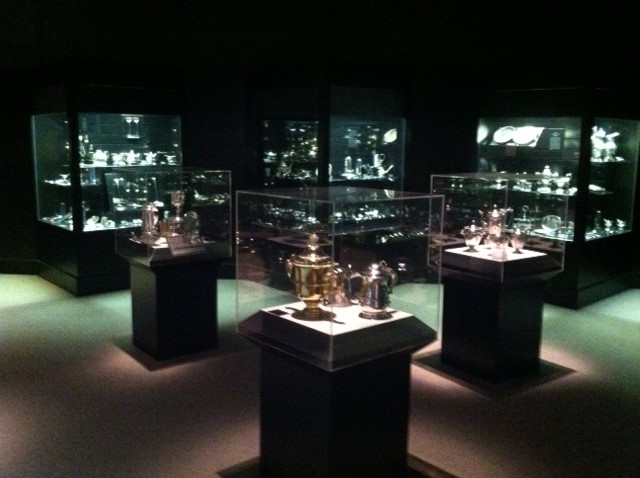 |
| The Loeblein Gallery of Charleston Silver displays a number of exquisite works dating from the colonial era through to the Victorian age. |
 |
| Chamber pots on display in the museum's bathroom entrance. |
 |
| Privy trivia on the back of the bathroom stalls. |
