Showing posts with label Virginia Geraty Papers. Show all posts

Saturday, June 1, 2013

Ardra Whitney: Week 39 @ Avery Research Center (Over and Out!)

My celebration song!

Monday, May 27th - Tuesday, May 28th:

With the two days I had left before returning to New York, I focused on bringing my labeling and arranging of folders from the Virginia Geraty Papers to completion. To expedite the process I pulled all the dated notebooks from the collection I had inventoried and labeled these folders first. Then I worked on labeling folders for the undated notebooks. I also reviewed the folder contents from the correspondence series in order to take notes, which I would use towards creating the collection’s finding aid. On Tuesday, Manager of Archival Services, Aaron Spelbring treated me to a farewell lunch at Bull Street Gourmet & Market; where we talked about our previous jobs before coming to the Avery Research Center, apartment hunting in Chicago, and the strong nose-tingly heat from my Bull Street Club sandwich’s dijonaise sauce. Before leavingProcessing Archivist, Georgette Mayo gave me a big hug and we exchanged thank you’s: her, for all my hard work during this nine-month residency and me, for all the great lessons learned and experience gained through it.

Ardra Whitney: Week 38 @ Avery Research Center

More Fellowship Extras: A photo of the topiary outside of the Family Circle Tennis Center at this year's Family Circle CupScroll to the end for details.

Monday, May 20th:

I was asked by Manager of Archival Services, Aaron Spelbring to monitor the reading room and provide reference service to a patron researching the family papers of DeCosta-Seabrook, Sterrett-Hodge and Graves for a book she’s writing. I have mostly performed virtual reference up until now, so this opportunity gave me a chance to employ my in person reference service skills to engage the researcher in a polite and friendly manneras well as suggest other collections she might be interested in viewing, inform her about Avery’s policies concerning the reproduction of collection materials and make her overall visit a pleasant and enjoyable one. The patron explained that she was from Idaho, but had lived in Charleston at one point. She also told me about a Charleston high school she had learned about from Harlan Green, Director of Archival and Reference Services at College of Charleston, which was integrated in the 1930s (thirty-three years before Rivers High School of Charleston became know as the first racially-integrated high school in the state of South Carolina). She learned from prior research at the Post & Courier archives that the school was once located at either George or Society Street; so as part of her research at Avery, she was looking for documents  to confirm the school’s true location.  

Tuesday, May 21st - Wednesday, May 22nd:

On Tuesday morning I participated in an IMLS Fellows Conference Call with The HistoryMakers to discuss final reports, paychecks, employment plans/job offers, and the 2013 SAA Conference. It was great hearing from all the fellows regarding their completed or nearly completed work (*smile*) and their plans following the fellowship. I found what Woodson Regional Library’s (Vivian G. Harsh Research Collection of Afro-American History and Literature) IMLS Fellow, Skyla Hearn and the Mayme A. Clayton Library & Museum’s IMLS Fellow, Chaitra Powell had to say particularly interesting. Ms. Hearn explained that she was in talks to do some consulting work at Northeastern Illinois University for the Carruthers Center for Inner City Studies Archives. Also Ms. Powell will be presenting next week at “Never the Same: Symposium on Grassroots Archiving” at the University of Chicago’s Logan Center for the Arts. After the meeting, I spent the rest of the day labeling and arranging folders from the Virginia Geraty Papers’ and was able to complete the collection series containing educational and instructional material.

On Wednesday, I e-mailed images of myself and from two collections which I had recently processed (i.e., The St. Mark’s Episcopal Church Records and Friendly Union Society Records) to Associate Director, Deborah Wright for inclusion in Avery’s newsletter.

Thursday, May 23rd:

At 11AM I met with Mr. Spelbring and Processing Archivist, Georgette Mayo to discuss archival staff updates and my departure from Avery in conclusion of the fellowship. Afterwards, I continued labeling folders from the Virginia Geraty Papers’ notebooks sub-series with the help of Avery Scholar, Jada Brown and Front Desk Receptionist, Emma King. At 4PM I attended and participated in The HistoryMakers’ last monthly professional development conference call with the Head of Collections/Technical Services at Indiana University’s Archives of African American Music and Culture (AAAMC), Brenda Nelson-Strauss. During the call, she discussed the many challenges of: acquiring collections from popular musicians and music artists, preserving and storing large music collections, and digitizing older audio formats. I also asked her about: the AAAMC’s collection strengths, their providing workshops to musicians on how to create and maintain personal archives, and the status of their grant program--funded by the GRAMMY Foundation--to digitize interviews from Rhythm & Blues pioneers. With regards to the Rhythm & Blues pioneers digitization project, She noted that Indiana University and Northwestern University were currently working together to code and load audio and video interviews from the project for online access using an open source discovery interface they created called Avalon Media System.

Friday, May 24th:

I continued labeling and arranging folders from the Virginia Geraty Papers’ notebooks sub-series with the help of my two volunteers, Ms. Brown and Ms. King. Our combined efforts brought the total number of completed boxes from the collection to nine out of eleven. I also posted an audio clip from my interview with Associate Professor in Arts Management at the College of Charleston, Dr. Karen Chandler to Black in the Lowcountry’s Tumblr page. I’m really proud of how well the page turned out. :)

Fellowship Extras Continued:
I got tickets to the final tennis match of the 2013 Family Circle Cup between Serena Williams and Jelena Jankovic!

Williams and Jankovic preparing for their match, which Williams won in three sets.

Saturday, May 25, 2013

Ardra Whitney: Week 37 @ Avery Research Center


Fellowship Extras: A video clip from my trip to the Charleston Museum two Saturdays ago on May 11th. I had been taken photos of the museum's various exhibits and didn't realize I had switched my iPhone camera to record. Scroll to the end to see more photos of my visit.

Monday, May 13th - Tuesday, May 14th:

I continued my processing work on the Virginia Geraty Papers: foldering collection materials, labeling folders and drafting the collection’s finding aid. By Thursday, I had completed work on approximately seven out of nine boxes from the collection. On Tuesday, I finally got a chance to add Cynthia McCottry-Smith’s interview on the Phillis Wheatley Literary and Social Club and Manager of Archival Services, Aaron Spelbring’s interview on the Abolitionist Map of America project to Avery’s Z: drive. Avery’s Resident Scholar, Dr. Dwana Waugh and myself have been trying to upload these interviews for some time now but there always seemed to be some computer issue preventing us from doing so. I remember one time when we were trying to upload the interviews, the computer we were working on didn't have the Z: drive mapped to it. Another time, we tried burning the interviews to CDs but the files were too big to transfer. At any rate, they’re on there now. Phew!

At noon, I corresponded with Processing Archivist, Georgette Mayo and Administrative Assistant, Savannah Frierson, via e-mail about enlisting the help of some volunteers to assist me with wrapping up processing on the Virginia Geraty Papers. Ms. Frierson and I drafted an announcement calling for volunteers, which she out to students in the Avery Scholars program. The scholarship program was established to increase enrollment at the College of Charleston of “first generation, underserved and economically disadvantaged students.”

Wednesday, May 15th - Thursday, May 16th:

In the morning, I prepared a brief report on my work to-date at Avery Research Center for this month’s final IMLS Fellows Conference Call with The HistoryMakers. After that I checked my College of Charleston e-mail account and saw I had received an e-mail from student, Jada Nicole Brown; expressing her interest in volunteering for the Virginia Geraty Papers processing project. I was thrilled to her response and happily replied— asking her about her availability. Now I’m just waiting to hear back from her, so we can arrange her volunteer schedule. Also on Wednesday, Thursday and Friday, I updated Avery’s Facebook and Twitter pages with posts about African American history, culture and current events. Doing this gave me the opportunity to check out Virtual Photo Walks on Google+ and YouTube. Viewing the project made me think it might be a viable social networking tool to promote tours of Avery online, in addition to walking tours pertaining to black history in Charleston.

Friday, May 17th:

I returned to Beaufort, SC to continue my research on the Beaufort District Collection’s materials relating to Hoodoo and African American folk magic traditions. Librarian, Charmaine Seabrook took photos of former Beaufort Sheriff J.E. McTeer’s scrapbooks for me to include in my poster presentation for the 2013 SAA Conference in New Orleans. Earlier in the week, Librarian, Grace Cordial sent me a request form for permission to publish reproductions and graphic images from the Beaufort County Library; I completed and printed the form to give to her once I had uploading the scrapbook images to my computer. Afterwards I reviewed materials I didn’t get to see during my first trip, like typed correspondence from Albert F. Sulprizio suggesting ways McTeer could secure funds for a motion picture of his book: Fifty Years as a Low Country Witch Doctor.

While the Beaufort County Library holds personal collection items from Sheriff J.E. McTeer, it holds none from McTeer’s infamous rival, Stephaney Robinson, a.k.a “Doctor Buzzard”. My research left me wondering if there was a relative, friend or some other person connected to Robinson that I could contact to learn more about him. Luckily, one of the items I discovered during my research at the library was an article on Artists, Andy and Bernice Mitchell Tate. Back in December the husband and wife created an art exhibit based on the legends and factual history of Doctor Buzzard. Mrs. Tate also had an exhibit at Avery in September of 2012, titled: Remembering “Her” Time. The exhibit was a tribute to Tate’s mother, Veronica Robinson-Mitchell, and explored the collective spirit of African-American female identity and womanhood. I am making plans to contact Mrs. Tate, so that she can share with me what she and her husband learned about Doctor Buzzard in preparation for their exhibit, Doctuh Buzzard’s Rootworks

Fellowship Extras Continued:
Free Badge: Copper, Charleston, 1783-1789. "Like the copper labor badges issued to working slaves in Charleston, free badges were dispensed as a method for identifying 'free negroes' within Charleston's city limits".
 Indigo: Natural Blue Dye in the Lowcountry An Original Exhibition.
"Because of its range of blue color and lightfastness, [indigo] was easily the most popular natural blue dye for many centuries. Before the advent of synthetic dyes in 1856, all yarn and fabric was dyed with natural dyestuffs. Indigo, a leguminous plant grown in many parts of the world, did not thrive in Europe. Obtaining quality, affordable indigo was a challenge for Europeans and colonists until the 18th century when a young girl from the South Carolina Lowcountry, named Eliza Lucas Pinckney, achieved this goal. Carrying out her father’s instructions with the benefit of an enslaved labor force, Pinckney succeeded in making the South Carolina Lowcountry a prime cultivator of indigo, which in turn allowed the plant to become a rich cash crop second only to rice."
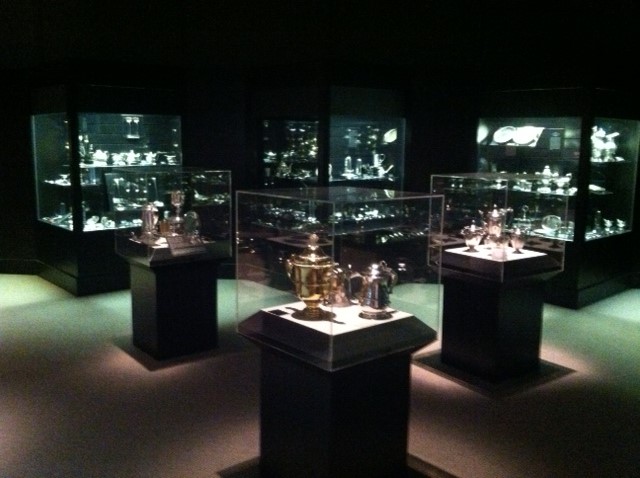
The Loeblein Gallery of Charleston Silver displays a number of exquisite works dating from the colonial era through to the Victorian age.
Chamber pots on display in the museum's bathroom entrance.
Privy trivia on the back of the bathroom stalls.

Sunday, May 19, 2013

Ardra Whitney: Week 36 @Avery Research Center

It's gettin' to be that time...
Monday, May 6th:

With the conclusion of the fellowship approaching, I was asked by Assistant Director, Deborah Wright to submit an essay on my residency experience at Avery Research Center for inclusion in the Center’s newsletter. I spent the weekend reflecting on my growth and development from these past eight months at Avery and reviewing old blog entries and monthly reports, so that by Monday I was able to submit the requested article to Ms. Wright—along with two brief announcements on recent collections I had processed.

Tuesday, May 7th - Thursday, May 9th:
Throughout the week, I continued foldering collection materials and labeling folders from the Virginia Geraty Papers. By Friday, I had completed roughly four and a half of the collection’s nine boxes. Also, in preparation for finalizing processing on the collection’s educational and instructional material series, I asked Processing Archivist, Georgette Mayo about retention rules governing student work in South Carolina. The series contains Gullah language exercises completed by former students of Geraty, so I wanted to confirm whether or not I would have to separate these items for restriction in accordance with the Family Educational Rights and Privacy Act of 1974 (FERPA), which protects the privacy of student education records.
Friday, May 10th:
On Friday morning, Ms. Mayo and I walked over to the College of Charleston’s Addlestone Library to attend a presentation on managing 21st century academic archives from Bobby R. Holt—a prospective candidate for the library’s Head of Special Collections position. I enjoyed Mr. Holt’s points about needing to change students’ perception of archives, as well as the importance of implementing aggressive outreach initiatives to draw students in, and building relationships with other academic libraries and archives through partnerships. After Holt’s presentation, I returned to Avery and posted photos from the C.A. Brown High School yearbooks, which had been scanned at Trident Technical College - Palmer Campus, to Black in the Lowcountry’s Tumblr page.

Tuesday, May 14, 2013

Ardra Whitney: Week 35 @ Avery Research Center


Monday, April 29th - Tuesday, April 30th:
I continued my work on the Virginia Geraty Papers by removing the metal spiral bindings from the collection’s 227 notebooks and foldering them individually. On Tuesday afternoon, I attended Avery’s weekly staff meeting where we discussed: collection and historic property assessment grants, opportunities to present on Avery’s archival collections, developing a free people of color and Philip Simmons walking tour app in partnership with Lowcountry Digital Library, educational tours and visits, Avery’s summer internship program, hanging the Cox family plaques for public viewing, recent acquisitions to Avery’s archives, and the deadline for Avery Messenger submissions—the Center’s quarterly newsletter. Before concluding my day, I contacted James Auclair at WBGH Stock Sales to inquire about using a screen shot of the Abolitionist Map of America as part of my Archivists and Archives of Color Roundtable (AACR) Newsletter article submission.

Wednesday, May 1st - Friday, May 3rd:
In the latter half of the week, I updated Avery’s Facebook and Twitter pages with posts pertaining to African American history, culture and current events. For example, since May starts off graduation season in the U.S., I shared an article on Facebook about Architect, Philip Freelon—lead designer for the Smithsonian Institute’s National Museum of African-American History and Culture in Washington, D.C.—delivering the commencement address at his alma mater, North Carolina State University. I also continued drafting the finding aid for the Virginia Geraty Papers; researching Library of Congress subject headings and filling in the collection arrangement section. On Friday, I submitted the article I had written on my interview with Manager of Archival Services, Aaron Spelbring and his digitization work for Abolitionist Map of America project to the AACR Newsletter Editor, Stacie Williams. A day prior to e-mailing the article, I took a few snapshots of Mr. Spelbring in front of Avery’s digital scanning workstation to include with the submission. After the photo session (lol), I had the pleasure of viewing the tribute book from the Craft and Crum Families collection, which Mr. Spelbring had mentioned during our interview. I asked to see it because he said it contained the signature of noted abolitionist and author of Uncle Tom’s Cabin, Harriet Beecher Stowe. When he showed me Stowe’s signature, I was in awe. The opportunity to observe this important and valuable piece of history reinforced for me how truly awesome and rewarding it is to be an archivist.

Sunday, April 21, 2013

Ardra Whitney: Week 32 @ Avery Research Center


Monday, April 8th - Tuesday, April 9th:
I sent Mr. Thomas McTeer a thank you note for my visit to his home in Beaufort, SC. In the note I expressed my enjoyment in having the opportunity to learn about his father, Sherriff J.E. McTeer’s experiences with the practice of Voodoo and Hoodoo in South Carolina’s Lowcountry, as well as my appreciation for the free copy of his father’s memoir he gave me. I also e-mailed librarians, Grace Cordial and Charmaine Seabrook, at the Beaufort County Library to request a follow-up visit to complete my research on the library’s collection of materials pertaining to Hoodoo.

Wednesday, April 10th:
In the morning I posted an announcement to both Avery’s Twitter page and Not Just in February Blog, calling for papers and panels for the Fall 2013 Conference and Symposium, “Unleashing the Black Erotic: Gender and Sexuality—Passion, Power, and Praxis”. This year’s conference and symposium seeks to provide a forum where participants can articulate the wide, varied, and expansive nature of gender and sexuality, and the performance of both. It also aims to teach African Americans how to understand, embrace, and harness the power, beauty, and essence of the erotic as a key to their positive evolution as people. The conference and symposium is inviting proposals from across disciplines, but is most interested in proposals that address aspects of: black bodies in popular culture; black sexuality in television, film, and literature; queering the black body in art and performance studies and iconic black queer motifs; sexuality and black faith; black women and the politics of respectability; black erotica, romance novels and comic books; the black body and public health; hip hop and the hypersexuality of black women; alternative modes of black love and family; and the politics and economics of porn.

In the afternoon I created a favicon, using PowerPoint, for Black in the Lowcountry (BIL): Digital Photo Archive’s Tumblr page and also posted a second round of photos to the page. According to Wikipedia, a favicon— also known as a shortcut icon, Web site icon, URL icon, or bookmark icon— is a file containing one or more small icons that is associated with a particular Web site or Web page. “Browsers that support a tabbed document interface typically show a page's favicon next to the page's title on the tab.” For BIL’s favicon I decided to go with a digital artwork titled, Uncle Remus Triptych (2011). The work features images of three characters from African-American folklore: Uncle Remus, Brer Rabbit (Brother Rabbit) and Tar Baby. I chose this work because while processing the Virginia Geraty Papers, I came across manuscripts and printed drafts for children’s books by Geraty featuring the animal trickster, Brer Rabbit. Geraty’s translated versions of popular African American folktales reflect the rich storytelling tradition of the Gullah people; that too were influenced by African and Native American oral traditions and include stories about the antics of animal tricksters such as Brer Fox, Brer Bear, Brer Wolf— in addition to Brer Rabbit. And in the same way that these folktales impart meaningful lessons to their listeners, I want BIL to teach viewers to see the value and historical significance of the African-American experience in the South Carolina Lowcountry.

Thursday, April 11th - Friday, April 12th
A little after 9AM, Graduate Assistant, Daron Calhoun II and I entered into a wonderful conversation about the books: Janie Mitchell, Reliable Cook: An Ex-slave’s Recipes for Living by Lisa Foster and Mary Lou Coombs and The Education of Blacks in the South, 1860-1935 by James D. Anderson. We also spoke about the history of African American Higher Education in the South, the founding history of Morehouse and Spelman College, the Hampton Model of Normal School Industrial Education, and the fundraising efforts of Marcus Garvey and Booker T. Washington— specifically Garvey’s appeal to the Klu Klux Klan to fund his UNIA-sponsored movement for repatriation to Africa and Washington with his U.S. fundraising tours, which allowed him to finance court cases that challenged the disenfranchisement of blacks in America.
During the latter part of Thursday, I had a chance to complete and return my poster presenter agreement form for the 2013 SAA Conference via e-mail. Throughout the week I continued processing series from the Virginia Geraty Papers and by Friday I had completed work on approximately fourteen of the collection’s eighteen proposed series and sub-series. These series included: educational and instructional material, ephemera, literary productions and manuscripts, lists, maps, oral history materials, and documents pertaining to the production of Geraty’s Porgy: A Gullah Version, which was performed at Charleston’s Garden Theater in 1995.

Thursday, April 11, 2013

Ardra Whitney: Week 31 @ Avery Research Center


Monday, April 1st:
With Monday being April Fool’s Day, I took to Twitter posting a link to Google Nose BETA, which I had read about in an online article from the Huffington Post. I thought it was such a well thought out; well executed and hilarious practical joke, and I really enjoyed the premise of it. Throughout the rest of the day I continued working on the Virginia Geraty Papers—processing the collection’s biographical and professional material series.

Tuesday, April 2nd - Wednesday, April 3rd:
I began the day by reblogging photos which I had collected for the Black in the Lowcountry: Digital Photo Archive project. I was really pleased with the outcome and look forward to perhaps receiving more submissions to post to the projects Tumblr page. On Wednesday, Graduate Assistant, Daron Calhoun II and I shared our thoughts on the inaugural undergraduate essay contest submissions. He explained that the announcement for the winners would be going out at the end of the week—and so I should finalize my decision by Thursday.

Thursday, April 4th:
By the end of the day, I completed processing two more series from the Virginia Geraty Papers: correspondence and drawing/illustrations. Additionally, I reviewed and ranked essays provided by Assistant Professor, Jon Hale for Avery’s inaugural undergraduate essay contest and e-mailed my decision to Manager of Archival Services, Aaron Spelbring. While waiting for my bus home to arrive, I received a call from Thomas McTeer, son of J.E. McTeer, a famous Lowcountry Sheriff and Witch Doctor. He was returning my call about visiting him and also answered my question about the best way to get to his home in Beaufort, SC.

Friday, April 5th:
I had been planning Friday’s trip to Beaufort since March, in order to conduct research for my SAA poster presentation on the African American folk magic tradition of Hoodoo. Renting a car from a nearby Avis, I drove in the morning to the beautiful and culturally rich town of Beaufort—my first stop was Mr. McTeer’s home. Mr. McTeer was very nice and had a free copy of his father’s memoir, Fifty Years as a Low Country Witch Doctorwaiting for me; along with a small collection of his father’s belongings. The collection included a medium sized tin containing roots his father had removed from people who had been hexed, a carved mandrake root which symbolized his father’s power and potency as a witch doctor, and scrapbooks containing news clippings his father collected during his work as both a local sheriff and Hoodoo practioner.

After speaking with Mr. McTeer about his father’s collection, he graciously directed me over to my next stop— the Beaufort County Library (BCL). There I met with librarians Grace Cordial and Charmaine Seabrook of the Beaufort District Collection, who brought out several vertical files, books, correspondence and news clippings on the practice of folk magic in the Lowcountry for me to look at and take notes on. I am planning a return trip to the BCL, so that I can review its collection of scrapbooks from J.E. McTeer, as well as literary productions on microfiche pertaining to the topics of Hoodoo and African-American folk magic.

Thursday, April 4, 2013

Ardra Whitney: Week 30 @ Avery Research Center

Monday, March 25thTuesday, March 26th:

I began the week with continuing my work on the Virginia Geraty Papers and was invited by Curator, Curtis J. Franks to sit in on Resident Scholar, Dwana Waugh’s morning interview for Avery’s Public Historian position. In the afternoon, Processing Archivist, Georgette Mayo and I gathered around the new workstation in the processing lab, where Manager of Archival Services, Aaron Spelbring provided us with a tutorial on how to use Archivists’ Toolkit (AT). Mr. Spelbring also taught us how to create records and finding aids in AT using my completed finding aid for the Friendly Union Society Records, which I prepared in NoteTab.

On Tuesday I met with Founder/Executive Director of The HistoryMakers, Julieanna Richardson for her site visit to Avery. Ms. Mayo picked her up from the airport and when she arrived at Avery, Mr. Franks took Ms. Richardson on a tour of the Center. Afterwards, she and I spoke briefly about my residency experience at Avery, as well as my plans following the fellowship. While Ms. Richardson, Ms. Mayo and Assistant Director, Deborah Wright met with one another in the Phillis Wheatley Literary and Social Club Reading Room, I took a break from my collection processing to attend Derek Alderman’s lecture, "Pressing the RESET button on Southern Hospitality: African American Belonging and Tourism Justice." Dr. Alderman is Chair of the Geography Department at the University of Tennessee and during his lecture he touched on topics of public memory, popular culture, and heritage tourism in the U.S. South. He also proposed that African Americans could look to achieve a broader sense of social and spatial justice if they focused on commemorating their past and shaping cultural landscapes to reflect their perspectives and experiences.

Wednesday, March 27th Friday, March 28th:

At half past eleven on Wednesday, I was invited by Mr. Spelbring to attend Mary Battle’s question and answer session as part of her interview for Avery’s Public Historian interview. Ms. Battle is Project Coordinator of the Lowcountry Digital History Initiative at the College of Charleston. Throughout the day I posted pertinent online articles and announcements to Avery’s Twitter page relating to our new ongoing exhibit on the Phillis Wheatley Literary and Social Club. By Friday I had completed surveying the Virginia Geraty Papers. I also touched base with Ms. Waugh and Mr. Spelbring about uploading the interviews I conducted with members of the Phillis Wheatley Literary and Social Club to Avery’s Z: drive. 

Thursday, March 28, 2013

Week 29: Ardra Whitney @ Avery Research Center

Monday, March 18th:

Administrative Assistant, Savannah Frierson and I worked on scanning and printing images of materials selected for display in the Phillis Wheatley Literary and Social Club exhibit—materials which included, a thank you note to the club from W.E.B. DuBois (1925); correspondence from Mary McLeod Bethune to Mrs. Miriam D. Seabrook (1931); and a press release announcing the club’s sponsorship of an exhibit of art works and paintings by black artists for the Spoleto Festival (1978). Although before we could get started, she had to install the two office printers to the new workstation computer in the processing lab. While scanning materials from the Phillis Wheatley Literary and Social Club Papers with Savannah; club member, Cynthia McCottry-Smith stopped by to follow up with me about locating photos of the club’s founder, Jeannette K. Cox to use in the exhibit. Ms. Smith also took some time to tell me about members of the club pictured in a circa 1949 photo. She recalled that one of the members taught her when she was in school and that another member’s husband owned a realty company in Charleston.

Tuesday, March 19th:

As I worked on placing the exhibit items, Curator, Curtis Franks and Assistant Director, Deborah Wright observed that the documents on display needed some form of support to prevent them from curling or bending. I agreed and so Mr. Franks went out and purchased some white mounting board to help reinforce the documents, which were placed on upright clear acrylic display stands. Mr. Franks was also able to find a large portrait of Mrs. Cox to hang as part of the exhibit. I was very happy about this because her image positioned over the exhibit materials serves as a wonderful focal point.
Wednesday, March 20th:

Throughout the day I continued surveying the Virginia Geraty Papers by making an item list of her many notebooks (and scrapbooks), which contain: lesson plans on Gullah grammar instruction; Gullah vocabulary; fables, poems and short stories translated into Gullah; as well as other literary productions and notes pertaining to Gullah language education/instruction.


Thursday, March 21st:
In the morning I met with Manager of Archival Services, Aaron Spelbring and Processing Archivist, Georgette Mayo to discuss department updates and submissions for the inaugural undergraduate essay contest. I also began processing the audio-visual material from the Virginia Geraty collection, which includes cassette tape recordings of her presentations and speaking engagements, lectures at the College of Charleston, and Gullah music; as well as video cassette tapes of television programs/films on Gullah language and culture.

In the afternoon, I participated in The HistoryMakers’ Monthly Professional Development Call with the former Chief Curator and Director of the Schomburg Center for Research in Black Culture and present Director of Howard University’s Moorland Spingarn Research Center, Howard Dodson, Jr. I enjoyed his remarks on the differences between museum and library curators, in addition to his observations on what makes a library successful.


Friday, March 22nd:
By the end of the week I had completed 11 out of 12 boxes from the Virginia Geraty Papers and began surveying the final box from the collection.