With the two days I had left before returning to New
York, I focused on bringing my labeling and arranging of folders from the
Virginia Geraty Papers to completion. To expedite the process I pulled all the
dated notebooks from the collection I had inventoried and labeled these folders
first. Then I worked on labeling folders for the undated notebooks. I also reviewed
the folder contents from the correspondence series in order to take notes,
which I would use towards creating the collection’s finding aid. On Tuesday,
Manager of Archival Services, Aaron Spelbring treated me to a farewell lunch at
Bull Street Gourmet & Market; where we talked about our previous jobs
before coming to the Avery Research Center, apartment hunting in Chicago, and
the strong nose-tingly heat from my Bull Street Club sandwich’s dijonaise sauce.
Before leaving—Processing Archivist, Georgette Mayo gave me a big hug and we exchanged
thank you’s: her, for all my hard work during this nine-month residency and me,
for all the great lessons learned and experience gained through it.
With the conclusion of the fellowship approaching, I was
asked by Assistant Director, Deborah Wright to submit an essay on my residency
experience at Avery Research Center for inclusion in the Center’s newsletter. I
spent the weekend reflecting on my growth and development from these past eight
months at Avery and reviewing old blog entries and monthly reports, so that by
Monday I was able to submit the requested article to Ms. Wright—along with two
brief announcements on recent collections I had processed.
Tuesday, May 7th -
Thursday, May 9th:
Throughout the week, I continued foldering collection
materials and labeling folders from the Virginia Geraty Papers. By Friday, I
had completed roughly four and a half of the collection’s nine boxes. Also, in
preparation for finalizing processing on the collection’s educational and
instructional material series, I asked Processing Archivist, Georgette Mayo
about retention rules governing student work in South Carolina. The series
contains Gullah language exercises completed by former students of Geraty, so I
wanted to confirm whether or not I would have to separate these items for
restriction in accordance with the Family Educational Rights and Privacy Act of 1974 (FERPA), which protects the privacy of student education records.
Friday, May 10th:
On Friday morning, Ms. Mayo and I walked over to the
College of Charleston’s Addlestone Library to attend a presentation on managing
21st century academic archives from Bobby R. Holt—a prospective
candidate for the library’s Head of Special Collections position. I enjoyed Mr.
Holt’s points about needing to change students’ perception of archives, as well
as the importance of implementing aggressive outreach initiatives to draw
students in, and building relationships with other academic libraries and
archives through partnerships. After Holt’s presentation, I returned to Avery
and posted photos from the C.A. Brown High School yearbooks, which had been
scanned at Trident Technical College - Palmer Campus, to Black in the Lowcountry’s Tumblr page.
I began the week with continuing my work on the
Virginia Geraty Papers and was invited by Curator, Curtis J. Franks to sit in
on Resident Scholar, Dwana Waugh’s morning interview for Avery’s Public
Historian position. In the afternoon, Processing Archivist, Georgette Mayo and I
gathered around the new workstation in the processing lab, where Manager of Archival
Services, Aaron Spelbring provided us with a tutorial on how to use Archivists’
Toolkit (AT). Mr. Spelbring also taught us how to create records and finding
aids in AT using my completed finding aid for the Friendly Union Society
Records, which I prepared in NoteTab.
On Tuesday I met with Founder/Executive Director of The
HistoryMakers, Julieanna Richardson for her site visit to Avery. Ms. Mayo picked
her up from the airport and when she arrived at Avery, Mr. Franks took Ms.
Richardson on a tour of the Center. Afterwards, she and I spoke briefly about my
residency experience at Avery, as well as my plans following the fellowship. While
Ms. Richardson, Ms. Mayo and Assistant Director, Deborah Wright met with one another
in the Phillis Wheatley Literary and Social Club Reading Room, I took a break
from my collection processing to attend Derek Alderman’s lecture,
"Pressing the RESET button on Southern Hospitality: African American
Belonging and Tourism Justice." Dr. Alderman is Chair of the Geography
Department at the University of Tennessee and during his lecture he touched on
topics of public memory,
popular culture, and heritage tourism in the U.S. South. He also proposed that African Americans could
look to achieve a broader sense of social and spatial justice if they focused
on commemorating their past and shaping cultural landscapes to reflect their perspectives
and experiences.
Wednesday, March 27th–
Friday, March 28th:
At half past eleven on Wednesday, I was invited by Mr.
Spelbring to attend Mary Battle’s
question and answer session as part of her interview for Avery’s Public
Historian interview.Ms.
Battle is Project Coordinator of the Lowcountry Digital History Initiative at
the College of Charleston. Throughout the day I posted pertinent online
articles and announcements to Avery’s Twitter page relating to our new ongoing exhibit on the Phillis Wheatley Literary and Social Club. By
Friday I had completed surveying the Virginia Geraty
Papers. I also touched base with Ms.
Waugh and Mr. Spelbring about uploading the interviews I conducted with members
of the Phillis Wheatley Literary and Social Club to Avery’s Z: drive.
Administrative Assistant, Savannah Frierson and I
worked on scanning and printing images of materials selected for display in the
Phillis Wheatley Literary and Social Club exhibit—materials which included, a
thank you note to the club from W.E.B. DuBois (1925); correspondence from Mary
McLeod Bethune to Mrs. Miriam D. Seabrook (1931); and a press release
announcing the club’s sponsorship of an exhibit of art works and paintings by
black artists for the Spoleto Festival (1978). Although before we could get
started, she had to install the two office printers to the new workstation
computer in the processing lab. While scanning materials from the Phillis Wheatley Literary and Social Club Papers with Savannah; club member, Cynthia
McCottry-Smith stopped by to follow up with me about locating photos of the
club’s founder, Jeannette K. Cox to use in the exhibit. Ms. Smith also took some
time to tell me about members of the club pictured in a circa 1949 photo. She
recalled that one of the members taught her when she was in school and that
another member’s husband owned a realty company in Charleston.
Tuesday, March 19th: As I worked on placing the exhibit items, Curator,
Curtis Franks and Assistant Director, Deborah Wright observed that the
documents on display needed some form of support to prevent them from curling
or bending. I agreed and so Mr. Franks went out and purchased some white
mounting board to help reinforce the documents, which were placed on upright
clear acrylic display stands. Mr. Franks was also able to find a large portrait
of Mrs. Cox to hang as part of the exhibit. I was very happy about this because
her image positioned over the exhibit materials serves as a wonderful focal
point.
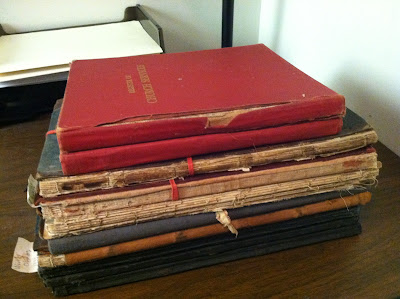
Wednesday, March 20th: Throughout the day I continued surveying the Virginia
Geraty Papers by making an item list of her many notebooks (and scrapbooks), which
contain: lesson plans on Gullah
grammar instruction; Gullah vocabulary; fables, poems and short stories translated
into Gullah; as well as other literary productions and notes pertaining to Gullah
language education/instruction. Thursday, March 21st:
In the morning I met with Manager of Archival Services,
Aaron Spelbring and Processing Archivist, Georgette Mayo to discuss department
updates and submissions for the inaugural undergraduate essay contest. I also began processing the audio-visual material from
the Virginia Geraty collection, which includes cassette tape recordings of her
presentations and speaking engagements, lectures at the College of Charleston,
and Gullah music; as well as video cassette tapes of television programs/films
on Gullah language and culture. In the afternoon, I participated in The HistoryMakers’
Monthly Professional Development Call with the former Chief Curator and Director of the
Schomburg Center for Research in Black Cultureand
present Director of Howard University’s Moorland Spingarn Research Center, Howard Dodson, Jr. I enjoyed his remarks on the differences between museum and library
curators, in addition to his observations on what makes a library successful. Friday, March 22nd:
By the end of the week I had completed 11 out of 12 boxes from
the Virginia Geraty Papers and began surveying the final box from the
collection.
This week I wrapped up work on the St. Mark’s Episcopal
Church Records. On Monday and Tuesday, I finalized folder headings; measured the
extent of the entire collection in linear feet—as well as each individual
series within the collection; and edited the collection’s finding aid, which I encoded
in EAD. I completed processing the collection on Wednesday by enclosing old
ledgers and parish registers in protective tissue paper and preparing box
labels for the collection’s ten boxes.
Throughout the week I posted photos and pertinent
online articles to Avery’s Facebook and Twitter pages—including a flyer for the
upcoming panel discussion on February 12th, “Bridge Builders: Faces of Black Professionals in Charleston”—sponsored by the College of
Charleston’s African-American Studies Department.
Thursday,
February 7th - Friday, February 8th:
On Thursday morning I began drafting an e-mail to send
to Trident Technical College’s Phoebe and Susan Williams. Back in fall of 2012,
I had assisted them with digitizing images from C.A. Brown High School’s
yearbooks and newspapers for the “Eastside Day” celebration and now I wanted to
see if some of the images I helped scan could be included in the Black in the
Lowcountry: Digital Photo Archive project. Subsequently, I corresponded with
Manager of Archival Services, Aaron Spelbring and Processing Archivist,
Georgette Mayo regarding my endeavor and they recommended that I draft an image(s)
request form to accompany the e-mail in order to outline the purpose for and
conditions under which the images would be reproduced.
On Friday, they reviewed my draft and offered up
suggestions for revisions. Additionally, I completed surveying the Friendly Union Society Records and drafted a finding aid for the
collection. The society was founded in 1813 to provide relief for widows and orphaned children and a place
of burial for its members. I
also began evaluating a video oral history interview from the sixteenth Supreme
Basileus of Alpha Kappa Alpha Sorority and former professor of
education at Southern University and A&M College, Dr. Julia Purnell.
Happy
New Year! On Wednesday I returned to the Avery Research Center refreshed from
my holiday break and ready to get right back into the swing of things. Over the
vacation, I began drafting a descriptive summary for the digital photo archive
project I had proposed earlier in the year. Hence, when I met with Processing
Archivist, Georgette Mayo on Wednesday morning, one of the first things we
discussed was the project—well that and 2012’s gripping holiday blockbusters,
“Django Unchained,” “The Hobbit” and “The Guilt Trip”. Ms. Mayo
explained that in order to display photos online submitted by the public, I
would need to get their permission via a photo use request form or policy
agreement statement. She also explained that her and Manager of Archival
Services, Aaron Spelbring would want to review photo submissions before
scanning and posting them in order to choose the most appropriate and relevant
images.
Throughout
the day I continued working on arrangement, description and finding aid
preparation for the St. Mark’s Episcopal Church Records. I researched dates for
news clippings from the collection that seemed to have none and asked Mr.
Spelbring about using cotton twill tape to secure the covers of ledgers, books
and other bound items that were coming apart due to age, wear and lack of
preservation.
Thursday, January 3rd:
I continued classifying materials from the St. Mark’s
Episcopal Church Records in order to create a folder/item list organized by
series for the collection’s finding aid. My run in with some painful paper cuts
reminded me of the importance of wearing gloves—not only to
protect the archival materials, but to protect myself as well. Additionally, I
continued my research on collection materials that I had initially deemed
miscellaneous. By learning more about the context and value of these materials
in relationship to St. Mark’s, the better I am able understand
how to describe them for reference and research purposes. For example, I am
currently researching the church’s affiliation with the Homebuilders
Association of Greater Charleston.
Friday, January 4th:
By
noon time I had finished a final draft of the descriptive summary for my
digital photo archive project and sent it to Ms. Mayo, Mr. Spelbring and Avery’s
2011-2012 IMLS Fellow, Aaisha Haykal, for feedback. Ms. Mayo was the first to chime
in with some points for discussion regarding the project, which she said we
could talk more about on Monday. I also completed description and arrangement for
four out of the nine proposed series of the St. Mark’s Episcopal Church
Records.
Somehow
I think the New Year is inspiring the writing of significantly more fantastic
articles on African American history and culture in South Carolina. I did a
Google search on Tuesday using the terms “African American history” and “South
Carolina,” which returned way more relevant hits than usual. By Friday I had a
favorites folder full of articles that I am looking forward to sharing on
Avery’s Facebook page.
Monday, December 10th: I
continued processing the St. Mark’s Episcopal Church Records throughout the
week and by Friday I had surveyed nine out of the collection’s ten boxes. I
think one of the most exciting things I came across during my inventory of the
collection was microfiche of the church’s register, offerings and cash books; all
dating from the earlypart of the 20th century. I was
like wow microfiche, that’s really neat! I also took some more time to research
the articles on James Baldwin from the James
E. Campbell Papers, 1930 – 2009, for the request made by the Ph.D student from
India. I followed up with him on Friday, providing him with the titles of the
articles, as well as the name and date of the publications they were in.
Tuesday, December 11th:
In the afternoon, IMLS Fellows participated in The HistoryMakers’ monthly professional development conference call with Virginia Historical Society’s (VHS) Curator of African American History,Lauranette L. Lee and Assistant Archivist, Paige Newman. The two discussed their work on the project, Unknown No Longer: A Database of Virginia Slave Names, which launched in
September of this year. VHS was presented with the C. Herbert Finch Publication
Award from the Mid-Atlantic Regional Archives Conference (MARAC) for the database. Unknown
No Longer launched
with 1,500 names but now has over 10,000 names entered
into the database. “It is the latest step by the Virginia Historical Society to
increase access to its varied collections relating to Virginians of African
descent.”
Wednesday, December 12th: I posted an article on Avery’s Facebook page about
the two music professors, Mary Ellen Junda and Robert Stephens from the
University of Connecticut studying Gullah culture in preparation to share their research
with 80 classroom teachers from across the U.S. Introducing teachers to the
Gullah people’s distinctive language and rich history is one way the professors
hope to combat age old stereotypes about the culture. Junda and Stephens also
want to help spread the word about Gullah culture in order to preserve its viable
and distinct traditions, which are quickly giving way to assimilation. Though on a sad note I was shocked to hear of the tragedy that struckNewtown, Connecticut on Friday. My thoughts and prayers are with the entire community during their time of incredible heartbreak.
Thursday, December 13th:
I completed
my interview evaluation for Entertainment Lawyer, Lisa E. Davis. Davis hails
from Queens, New York; so needless to say I was thrilled to hear her talk about
how her grandmother who lived in St. Albans used to take Davis shopping on
Jamaica Avenue. The avenue is a major thoroughfare that stretches from Queens
all the way into Brooklyn—I know it like the back of my hand and also have many
fond memories of it. Davis remarks in her interview that her paternal
grandparents were
the first black family to break the restrictive covenant act by moving to St.
Albans, Queens in 1946. In addition, she talks about the famous jazz musicians
that lived in St. Albans during the 1940s and 1950s. Jazz artists, Ella Fitzgerald, John Coltrane and Count Basie were all residents of the Queens
neighborhood.
Friday, December 14th:
I began
research on the history of St. Mark’s Episcopal Church in order to prepare a finding
aid for the collection. I also completed my weekly report to Processing
Archivist, Georgette Mayo and Manager of Archival Services, Aaron Spelbring, which
included my considerations regarding the preservation, storage and possible
digitization of the collection’s parish ledgers, registries and other historical
record books.
Q: Guess who’s going to see Nas perform at Radio City
Music Hall on New Year’s Eve?
A: Me!!!! “Now I'm the one that’s reppin’Queenswaybeyondyourwildestdreams”. Woooooooo!!!!
Monday, December 3rd:
With Manager of Archival Services, Aaron Spelbring’s
instruction, I made my final edits to the finding aid for the Edwina Harleston
Whitlock Papers. I also photocopied all news clippings from the collection and
used paper clips to fasten together loose and/or related materials. Afterwards,
I continued processing St. Mark’s Episcopal Church Records. Items surveyed included
church programs dating from 1939-1990, vestry proceedings from the early part
of the 20th century, and souvenir journals from the church’s 125th
anniversary celebration in 1990.
Tuesday, December 4th:
In the morning I followed up with Avery's Executive Director,
Dr. Patricia Williams Lessane regarding the writing of a description for undergraduate
internship opportunities at Avery, which she had mentioned at last Thursday’s
staff meeting. She also asked me to connect with one of Avery’s current
undergraduate interns to write a profile on them for the Avery Messenger. After work, I participated in the monthly IMLS
Fellows’ conference call with The HistoryMakers. Fellows provided The HistoryMakers' Executive
Director, Julieanna Richardson, Dan Johnson and Marta Grabowski with progress
reports on their work at each of their respective host institutions and learned
about new changes to The HistoryMakers’ interview evaluation process.
Wednesday, December 5thand Thursday, December 6th:
On Wednesday I e-mailed some public program ideas I had
for the upcoming year to Dr. Lessane, Mr. Spelbring and Processing Archivist,
Georgette Mayo. I also forwarded the message to Avery’s recently promoted
Assistant Director, Deborah Wright. Congratulations Ms. Wright! On Thursday, I
provided a brief coverage of the reading room for Mr. Spelbring and monitored patrons
as they viewed and handled collection materials for their research.
Friday, December 7th:
I answered a reference request regarding race, religion
and the writings of James Baldwin via Facebook— the request was from a Ph.D.
student all the way from India, so that was exciting. I also posted a flyer to Avery’s Facebook page regarding the
ceremony honoring South Carolina freedom fighters— Mary Moultrie, Ken Riley, William Saunders, and the Martyrs of the
Orangeburg Massacre— taking place that evening. The event kicked off the 9th Bi-Annual Southern Human Rights Organizers' Conference being held from December 7-9, 2012, at the International
Longshoreman’s Association’s Local 1422 Headquarters. I concluded the day by working on the St.
Mark’s Episcopal Church Records. During my processing, I came across some
really interesting materials like a journal from the late 19th century containing entries from parish
leadership, a bible published in 1866,
and an autograph from prominent Charleston architect, Louis
J. Barbot, who designed St. Mark's
church building.
At
the beginning of the week, I met with Processing Archivist, Georgette Mayo and
Manager of Archival Services, Aaron Spelbring to discuss revisions to the finding
aid draft for the W. Melvin Brown, Jr. Papers; the collection arrangement for
the Edwina Harleston Whitlock Papers; and creating EAD
finding aids in NoteTab.I alsocontinued my work with drafting a finding
aid for the Edwina Harleston Whitlock Papers: editing the biographical
and scope and content note; revising the collection’s series arrangement and
folder listandadding subject headings.Additionally,Ibrainstormed with Reference Librarian, Deborah Wright and Ms. Mayo about developing
potential programs, workshops, events and social media initiatives to raise
awareness about Avery’s archives.
Thursday, November 1st –Friday, November 2nd
By
Thursday, I had begun evaluating ArtMaker, Jawole Willa Jo Zollar’s video oral history
interview. Zollar is the founder of the all-female
African-American dance company, Urban Bush Women.
On Friday, I corresponded with Public Historian,
Robert T. Chase and spoke with Ms. Wright about an e-mail from Founding Director
of Lowcountry Africana, Toni Carrier, regarding Story Corps' National Day of Listening.
Monday, October 22nd: On
Monday morning, Processing Archivist, Georgette Mayo shared with me that she
would be participating in the South Carolina Library Association (SCLA) Annual Conference 2012. Her group’s panel was entitled, “Stand Up and
Shout! Sit Down and Negotiate” and included both library and archives
professionals as speakers. She explained that panelists would discuss their
experiences in advocating for South Carolina’s libraries, as well as their
efforts to develop and implement advocacy programs and initiatives across the
state that engaged and guided others in library advocacy. Ms. Mayo told me that
she was planning to mention my work with Avery’s social media campaign for American
Archives Month in her portion of the panel discussion and wondered if I could
provide any further insights into using social media as a tool for library and archives
advocacy. From there, we entered into a wonderful conversation about the role
technology, and more specifically the Internet, has played in democratizing
archives and increasing the public’s awareness about historical materials
present in archives and libraries. We also discussed archives advocacy in the
form of incorporating archival material into educational curricula and
activities. I mentioned something I had seen recently from the US National Archives
called, DocsTeach, an online teaching tool that
"enables educators to find and create interactive learning activities with
primary source documents". During the course of our conversation, Ms. Mayo shared
her copy of Archives Power: Memory, Accountability, and Social Justiceby Randall C. Jimerson with me. I first learned of the book when having a similar discussion
with one of the archives interns at Weeksville Heritage Center about how the
digital revolution has led to greater accessibility to archival material.
Tuesday, October 23rd:
In the afternoon, I attended the “Between the Tracks at 25” symposiumat Trident Technical Collegewith
Ms. Mayo and Manager of Archival Services, Aaron Spelbring; where scholars, community
leaders and audience members met to celebrate the 25th anniversary
of the book Between the Tracks: Charleston’s East Side During the Nineteenth Century. Between the Tracks was published by the Charleston Museum and
Avery Research Center in 1987 and was designed to encouragea variety of endeavors related to the history
and heritage of Charleston’s Eastside community, including: archaeological
research, historic preservation, new construction, public education,and community programs. I received a
mention during the symposium's introduction from Dr. Susan Millar Williams for
my participation on the Eastside Day Planning Committee. (I was
honored by the acknowledgement.) Avery’s Education Outreach Coordinator, Shelia Harell-Roye who
lived in Eastside at one time, was one of the symposium’s speakers and talked about
the valuable life lessons she learned growing up in the neighborhood. I also
had the opportunity to meet Martha Zierden of the Charleston Museum, who was one
of the contributors to Between theTracks. Ms. Mayo was kind enough
to introduce Mr. Spelbring and myself to Ms. Zierden.
Wednesday, October 24thand Thursday, October
25th:
On Wednesday, I posted a quote from Andrea Jackson’s(Head of the Archives
Research Center at Robert W. Woodruff Library, Atlanta University Center) professional development call with IMLS
Fellows to Facebook as part Avery’s American Archives Month social media
campaign. On
Thursday, I completed revisions to my evaluation form for part two of Debra
Lee’s video oral history interview. It was so great listening to Lee talk about
witnessing the election of America’s first African American president. In her interview,
she makes a very perceptive observation and connection about the president’s
election and the Brown v. Board of Education decision of 1954. In the afternoon, I attended the
all library staff meeting with Mr. Spelbring at the College of Charleston’s Addlestone
Library. At the meeting, various staff members discussed recent acquisitions to
the library; upcoming events and exhibits; and approved a new library policy
concerning eating, drinking, cell phone use and other behavior prohibited in
the library.
Friday, October 26th:
I completed
the physical collection arrangement and editing of the finding aid draft for
the W. Melvin Brown, Jr. Papers. I also established the series and folder
arrangement for the Edwina Harleston Whitlock Papers and continued
developing the biographical and scope and content note for the collection’s
finding aid. Additionally, I created photo albums on Avery’s Facebook page for Mrs. Harell-Roye’s
photos of the 10th anniversary celebration of The Tammy Show; the unveiling of the C.A. Brown High School historical marker and the Eastside neighborhood walking tour. I
also forwarded Ms. Mayo e-mails from followers of Avery’s Facebook page, so that we can stay
knowledgeable about what is important to Avery’s followers; remain connected
and engaged with them; and continue to show them that we care about what matters to
them.

.JPG)